Support the Site!
Enter text related to supporting the site
Make a DonationTalks on The Yoga Vasistha — 1982
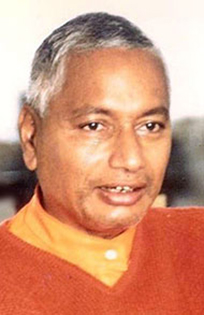
These talks on the Yoga Vasistha form the final talks given as a series that Swami Venkatesananda delivered in the closing months of 1982, the year of his MahÄsamÄdhi, thirty-seven years ago. Each talk was delivered weekly to small yet attentive audience in Fremantle Australia, at the Beacon Hill Yoga Centre, where the series was recorded on video tape. Some of the footage was superficially damaged when editing the master tapes for a film biography which was released at a later date. Fortunately, the recordings are not damaged to the extent that they can't be viewed. We thank those responsible for preserving these talks and making the series available here.
Talk 01: Beyond Purpose, Doctrine & The 'Me'
Let's have look into an inspiring though not extremely popular text called the Yoga VÄsiá¹£á¹ha. It’s sublime, but it is not as well-known as for instance the Bhagavad GÄ«tÄ or the Upanishads.
The purposes invented by the me may be necessary, may be expedient in our lives, may make our lives run in an orderly and smooth ways, but the fundamental problems that plague our hearts and minds cannot be dealt with by such superficial means, by inventing a purpose. One day or the other, there will be disillusionment. Disillusionment is a good thing. One day or the other, there will be disillusionment, and there may be great shock, and it may be too late.
Before it is too late, is it possible for us to investigate the 'me', its relationships, the way it behaves, the movements that are associated with the 'me', and, by taking it to its own source, what consciousness, what life is – not what it is for, but what life is?
That is the theme of this Yoga VÄsiá¹£á¹ha which we will continue to discuss on the coming Saturdays.
Talk 02: Between Ignorance and Enlightenment
“Puzzled and bewildered by what we see around ourselves, which of course includes what we regard as ourselves, we begin to look for a meaning to all this. And since the observer, the me, the ego arises in life, it is unable to comprehend the true meaning, the totality of life. And yet, such is the nature of the inquirer that it cannot give up!
This is the paradox, this is the enigma, this is the puzzle. You don’t easily give up your attempt to understand something which you regard as vital. And so a compromise is affected: I don’t understand the meaning, or I cannot understand the meaning, so let me try to speculate on what might be the meaning, or more appropriately the purpose (of) why am I here.
I can make the distinction sort of (more) clear: What is the meaning of my coming here and sitting here? To contemplate the Yoga VÄsiá¹£á¹ha in your company. Isn’t it? That’s the purpose! Because, coming here and sitting here – what is the meaning of all this? Not merely the restricted purpose of talking about the Yoga VÄsiá¹£á¹ha, but a lot more! If the meaning of my coming here is merely to talk about the Yoga VÄsiá¹£á¹ha, I shouldn’t be drinking a glass of water, I shouldn’t be blinking, I shouldn’t be blowing my nose. The meaning is comprehensive. It’s vast, whereas the purpose can be very limited.
The meaning cannot be altered, the purpose can be modified as you go along. The meaning has to be discovered, the purpose is invented, manufactured, put together. Why is the purpose put together? Why does one ask “What is the purpose of life?” at all? Because we are unable to understand the meaning of life.
All philosophies, all theories concerning life, and what our duty is concerning life, what we should do and not do, “Thou shalt” and “Thou shalt not”, all these are products of inquiring into the purpose of life. It is valid as far as it goes. But, it is not adequate to bring satisfaction to the inquirer! “
Talk 03: An Awakening, The Arising of Viveka
How do you expect a thought to answer the question: “What is life?”
In that case: Do we have any other instrument of knowledge?
***
How does such a question arise and what does that question mean?
The Yoga VÄsiá¹£á¹ha, the Supreme Yoga, begins that way.
***
I won’t take much of your time telling the whole story.
***
The king asks RÄma to be brought to the court and hands him over as it were to one of the greatest sages of that time, Vasiá¹£á¹ha. And it was in answer to the sage’s questions that RÄma gives vent to his ideas. And the sage compliments him (…): “Wonderful! You have had an inner awakening! That is what I would call viveka.” (…) We are told that unless there is this stirring of this viveka in us, it is not possible to find an answer to the fundamental questions concerning life: What is the meaning of life? What am I here for? Who am I?
***
Viveka is something which questions: “What is the reality of this?” The reality is permanent, the unreality is impermanent. (…) But is the permanent something which can be seen, touched? Is there something which is permanent which can thus be defined? You don’t find anything as permanent as this! When you do not define those words – permanent/impermanent, real/unreal, then a different type of intelligence arises from that – if you keep inquiring into everything to see if it is real or unreal, if it is permanent or impermanent. Then a different, very different type of intelligence arises: "discrimination" (between the real and the unreal) arises, wisdom arises, and a certain attitude, a certain behavior, a certain vision flows from this "discrimination". This is viveka, and the action that flows from that is vairÄgya.
***
Viveka in that sense means absolute clarity of vision, absolute clarity of perception
***
Then, there is a revolution in your behavior.
Talk 04: Dreams & Awakenings — The Unconditioning of Awareness
One might be awakened from one dream, and might slip into another dream which for the time being the dreamer considers to be an awakened state.
***
But as soon as he was awakened, he slipped into another dream, calling it a state of waking. It is only from that point of view that some great masters assert that this awakening is also a process, and that there could be several series of awakenings.
***
There is an awakening which thinks that the world is outside: “The outside world is vicious, and I must renounce that!” That is an awakening. Quite valid. But that is not a complete and total awakening. There is a little more!
***
There is a second and a stronger awakening. And this stronger awakening leads to an even more drastic form of vairÄgya. And here, it it is not merely a sort of dispassion which can be an absence of passion, or absence of craving, (not merely the) absence of desire, but vairÄgya in the sense of uncolored-ness leading towards un-conditioning of the mind, or un-conditioning of the awareness.
Talk 05: Gatekeepers to the Door of Liberation - The Four Factors That Define Proper Self-Effort
Vasistha (says) “Yoga is the art of blending (or) harmonizing these actions (of self-effort) with destiny and with grace without trying to run counter (to them).” Hence, after having taught the “supremacy” of self effort, Vasistha reminds us that only that is self effort in which is there is harmony with dharma. What is dharma? The cohesive force or that which keeps us together; that which promotes harmony, integration of ones personality, harmony with others, with the entire cosmos, and leads us intelligently to the understanding of the state of freedom. That is self effort; not merely beating about the bush.
*** *** ***
The effort must be there and one should recognize that in making the right effort, one should ensure that the means are as right as the ends, that the instrument are as pure efficient and appropriate as is needed for the effort in the right direction. When you come to that, then immediately you realize that certain instruments like the senses (the eyes and ears and so on) are not appropriate instruments for understanding the meaning of life. When you come to that point, you realize that even the intellect or the mind is not the appropriate instrument for understanding, for knowing the meaning of life. And you also realize that assertive discipline is vital to fashion this instrument in such a way that it is able to probe and discover this truth. Otherwise, it cannot.
Talk 06: The Next (Revolutionary) Step — The Arising of True Self-Control In Consciousness
Last week we looked into Vasistha’ imagery of the hall of freedom, the hall of liberation, the hall of knowledge, wisdom and the four gatekeepers with whose help alone we would be able to enter this hall of wisdom. Self-control, self inquiry, contentment, and satsanga or the company, depleted in a very simple way. I suppose you realize that means nothing. You have to define what good means, what company means, all that.
Supposing with the help of all the four (gatekeepers), three, two or, by intensely cultivating the friendship of one of these, you are able to get to the door, and you begin to knock, and the most important factor here is to knock "Knock and it shall be opened!" Your knocking does not open the door. If you knock hard and long enough, maybe the skin comes off a few knuckles, but (laughs) it doesn’t open the door. Why?
*** *** ***
So, perhaps, when you knock, and eventually, when the door is opened, you see … (pause) … what do you see? You suddenly realize, that all that is seen is a projection of the seer. You may say or think it is an illusion. But, the seer of the illusion exists. You may think you see nothing, but the seer of nothingness … exists. Or, you may come back to that, the source of all wisdom: the seeker was already the sought, there is no distinction. The seeker was merely a word, moksha, liberation ,,, another word. Bondage is one word. Emancipation is another word. Illusion is one word, enlightenment is another word. We are living in a world of words!
Talk 7: The Observer, The Observed & Beyond
To some of you, I am a friend. To some of you, I'm a stranger. To that child, I'm just a noisy (laughs) … noisy man. But supposing a tiger happened to come here and look at me. To that tiger I am something entirely different: food, dinner! And depending upon the tag that you hang around your neck, your attitude towards me changes. This is the danger. Otherwise, you don't care. If she (pointing to a girl in the audience) were to be considered a girl by everyone in this world, there will be no problem. To someone she's a girl. To somebody else she's a daughter. To someone else she's a sister. To someone else, she is so-and-so, or so-and-so. And (because of that) that becomes) a problem, a very serious problem. Each one expects something else from her, something else out of her, and therefore, there's a problem.
So the world “as God created it,” to use a popular expression, is totally unknown to us! We have projected our own mind, our own thought into each one of those objects and meddled with it, distorted it. And this is also the latest theory of modern science; that the observer's interferes with the object by his observation, enters into the object and interferes with it. And that's what we have been doing.
*** *** ***
Can that be eliminated? Yeah, sure. And in order to eliminate that we must withdraw the mind from creation, from the object, from the objective universe. If we do not do that, then we keep pursuing these objects as if they were real and as if our lives are dependent upon them. Hmm. (as if) .. Happiness comes from them, unhappiness comes from them from them, salvation comes, bondage comes from them from them. What happens then is described in a fantastic story in the Yoga Vasistha called the (Mandapar) or the Story of Lila.
Talk 08: Creation, Consciousness & the Seven Forms of Self-Forgetfulness
It is a difficult but not impossible problem to understand the origin of creation for very simple reason that when you discuss something that someone else has produced, you have no idea how it was done, why it was done or if it was done at all. However, whatever this creation may be, it is something that happens at different levels and different timescales ...
**** **** **** ****
... this question of creation and the arising of objects and the consequent relationship that seems to come into being is of immediate concern to us.
**** **** **** ****
Consciousness did not create unconsciousness. Consciousness cannot even become conscious of something unconscious. Consciousness cannot come into contact with unconsciousness. Consciousness cannot grasp unconsciousness. Consciousness cannot comprehend unconsciousness. But you think you can.
**** **** **** ****
... consciousness being consciousness can think it is unconscious, just as a girl can play the role of a boy (in a play) , and a boy can play the role of a girl.
**** **** **** ****
... pure consciousness by thinking that it is unconsciousness creates a thing called mind space, a space within itself.
**** **** **** ****
... having created that thought space, there is self-forgetfulness, forgetfulness of oneself, and getting deeper and deeper involved in the other (…), in a way forgetting oneself, where self-knowledge is completely veiled and lost, and there is a total acceptance of the world as if it were an independent reality, as if my whole life is dependent upon that world ...
Talk 09: The Fall of Intelligence & The Descent into Degradation
When the dream goes on, and even that little awareness of the self as disintegrated, it becomes a sort of hallucination. There is not a terrible difference between the two. Whereas in the case of a dream, it is less long-lasting, in the case of an hallucination, it's more long-lasting and more firmly based. All our prejudices are based on hallucinations.
____ ____ ____ ____
“It must be the truth” is not the truth, yes? That's clear, isn’t it? When you are tempted to use the expression "it must be true", it is not true. If it is true, it is true. Why should I say it must be true? So what you hear from the religious leaders must become true to you! Then it becomes true. If that is not done in this hallucination grows into a sort of conviction (and) you convict yourself as an ignorant person. (...) ... if you examine your lives now, most of our action spring from these prejudices, the superstitious beliefs, these convictions which are unexamined and which according to most people are nonnegotiable. You can think about them. You can consider them. You can't examine them. They must be left intact. Actions that arise from the sum total of these prejudices is called mechanical action.
____ ____ ____ ____
Visceral action is very different from mechanical action. (...) ... if you examine visceral action, you will realize that it is diametrical opposite of prejudice. Visceral action is natural action. As long as your eyes are open, they will see. Whether it is an Indian swami that is sitting in front of you or a Scottish lady that is sitting in front of you. Look, look at me (the Inian Swami), look at her (the Scottish lady). The eyes don't say I don't want to look! But, your eyes will close if something which is glaring is turned up upon either of us.
Talk 10: The Return Journey Pt 1 — 1st Steps Towards The Reawakening Of Intelligence
Now, the return journey: how do we return to a state of awakened intelligence? How do we wake this intelligence up when it is moved away from its own center, moved into the world which it had created early in the morning, moved so far away from the center that the world seems to be a solid reality, and this intelligence fast asleep? How do we return to the source?
I must first confess that though the fall and now the return has sort of been mapped out into seven stages, Vasistha, as such, in his own teachings does not recognize any serious step-by-step procedure and technique. If in these two instances, some sort of a technique or step-by-step procedure has been taught, that's only because he doesn't stick to any particular doctrine: It is neither/nor!
"Are there any techniques?" "No!"
"Are there no techinques? "Oh Yes!"
Both! There are no absolutes except the absolute itself
Those of you who study the Yoga Vasistha might find these steps mentioned in two places, and (notice) the steps are slightly different. I have deliberately left it in a consused state merely to indicate that there are no absolutes! There are no dogmas here. There is no philosophical system here. If you are interested, go on .. investigate and see if there are seven steps. You can (might find) that you can skip two of them and mike it in five. Maybe you will need a couple of more steps, or one and half or two and a half. Take them!
Tape 11: The Return Journey Pt 2 — The Last Steps To The Full Awakening of Intelligence
I said a few minutes ago that you cannot see the mind. Nobody has seen the mind. When you look within, introspect, observe, you only observed within yourself and there is tremendous craving, hate, prejudice, this, that and a restlessness. These are the things that are observed.
So mind is a synonym for all those things. Mind is a synonym for restlessness. Mind is a synonym for impurity, craving, lust, anger, greed, vanity. You do not see that mind is some kind of a yoga hall in which all these things are playing or practicing yoga. You see only this fear is there, only anxiety is there, only restlessness is there. So this is mind. This is mind. And when these things have been eliminated by observation, they disappear and along with it, the mind is gone. Along with the impurity, mind is also gone.
____ ____ ____ ____
This is a peculiar philosophy of Vasistha. The Yoga Vasistha does not regard what we call evil qualities as temporary or permanent tenants of the mind. But he says these impurities are the mind. So when your observation removes these impurities, the mind is become no mind: dehydrated water. Water that is not wet (laughs). Water that is not wet. It's an extraordinary … philospophy.
____ ____ ____ ____
It is only then that the famous “virtue” and we've often discussed herein called “detachment” arises: asaá¹saktti, detachment. We are often told that one who seeks self-knowledge or god-realization must lead a detached life. Detached from what? That's the first question!
Talk 12: Ignorance Collapsing Into Its Own Source — The Infinite
It is only the idea that “ I am this body” (that) thinks of it as confined to the body. When the consciousness is freed from that, then nothing has any meaning whatsoever. None of the words that we have invented has any meaning whatsoever. That is the state of turÄ«ya where there is no bondage and therefore, there is no liberation, where there is no pain and therefore there is no pleasure, where there is no happiness and therefore there is no unhappiness. It is the same thing as the deep sleep state, except that there is full awareness or consciousness.
But that consciousness, — NOW WE ARE SLIPPERY GROUND —, is awareness. it is aware … (pause), it is aware! I And being aware, — please watch very carefully—, and being aware, it's aware of a speaker; it's aware of listeners; it's aware of somebody fallen asleep; it is aware of the camera; it's aware of the tape recorder. It is aware. It is aware of this person. It is aware of all these people. It is aware. And, it does not demand that all these should vanish before enlightenment is gained, because the distinction between enlightenment and non-enlightenment is also gone. Words! (...) The enlightened person does not regard himself as an enlightened person because in his case, enlightenment is just a word without any corresponding reality.
----- ----- ----- -----
As long as there is the ocean, there will be ripples. The ripples arise in the ocean, and funnily enough the ripples dissolved in the ocean. Why is it so? Because they were never separate! The ripples were the ocean and the ocean was the ripples. There is no distinction at all except in spelling. And therefore the enlightened person, — enlightened from our view, not from his point of view —, is able at the same time, simultaneously, to see that this is enlightenment, and that there are some people who think they are the body. Is that true that they are the body? No. Is it true that they think they are the body? Yes. And is it possible for them to be awakened? Sure. Can I do it ? No. Can they be awakened? Yes. It is in this tangle that the enlightened man functions, knowing fully well that even he cannot possibly bring about enlightenment in the minds of people.
----- ----- ----- -----
We are the manifestation of God's own infinite potential. And being sentient, we are bound to act and react upon one another. That's inevitable. Experience is inevitable. Experiencing is inevitable. But what Vasistha questions and very boldly questions is: why do you assume ownership or authorship of all these?
----- ----- ----- -----
Is it possible therefore, to appreciate the powers latent or inherent in consciousness, the omnipotence in consciousness, the omnipotence in the infinite being, and realize that the entire universe is the infinite being?
Talk 13: Essence of Renunciation
You are! Definitely, you are! I am! Definitely I am! But that there is a relationship between us that I can define you as nice, (or) as holy or unholy, etc. etc., all those things are my creation. I have the power to project ignorance. Unable to understand the mystery of the divine maya (or) the divine creation, and unwilling to accept that I cannot understand why you or all of us exist on this earth, I do not have the honesty to admit that is not my business. Somehow it seems to be my business. How can I live in this world without knowing who you are (or) who I am and how can I honestly say that I don't know and (that) it’s all right that I don't know?
So I take the easy way out: I pretend to know something which I do not. (…) All descriptions, all projections of this ignorance are from one point of view convenient clichés and from another point of view an unwillingness to own (our) ignorance.
——- ——- ——- ——-
Renunciation or abandonment of ignorance is vital! There is nothing that you do which can really lead to enlightenment. Why not? For a very simple reason: that which you do it is something done by this ignorance. I'm going to say "I did this.” Who did this? (…) I am not the author of this body. I am not the author of the speaking faculty, the faculty of speech. I am not the author of the brain cells. But somehow, the idea arises: I'm speaking and this speech, these ideas belong to me. So that, that knowledge or understanding or that renunciation, all these are totally independent from an action. Renunciation is not an action, because if I renounce something, in that renunciation is an I, ego. If I am sitting in meditation: “I am meditating,” the I is still there, the ego is still there. And it identifies itself with the body as if I am and this is my action. And therefore, there is no renunciation!
Talk 14: The Divine Life
Where do these thoughts, would these emotions, where do these feelings, where the so-called experiences arise? These are my creations and unless they can be effectively dealt with, there is no peace, there is no joy, nothing, there is no godliness, nothing. It doesn't matter what you appear to be.
----- ----- ----- -----
These things are not my creation. What is my creation? My creation is "I like this" or "I don't like this". Those things are not there in God's creation. Everything else is there. Consciousness is there. Life is there. Movement is there. Experience is there. Some kind of an ego sense is there. Attraction and repulsion is there (in the electromagnetic sense).
But "these things happen to me", that crystallization of personality is not there and as long as the world as the universe continues to exist, all these things will also be there. Don't try to rebel against these. These are not your creation and you cannot possibly exclude them, run away from them.
----- ----- ----- -----
Your problem is that you want it one way, and not the other way. Aha-ha – there is a problem: I want the world to be this way, and not another way. I want my life to go this way, and not another way. Hmm? There is a problem and that problem causes heart-ache. And that heart-ache is entirely yours, created by your own mind, your own problem. Your jealousy, your hatred, your ill-will, your love, your attachment are not shared by anybody else in this world! (Laughs.)
----- ----- ----- -----
Vasiá¹£á¹ha says: “There is no creator”.
“But what is all this?”
(Vasistha) “All this is God.”
“All this is God?”
“Yes. Remove your own creation from this world (and) whatever is … is God."
If you pull your own non-existent creation out of that picture, what remains is God. Try!